
Most Indians find out about a serious health condition in one of two ways: a sudden episode that lands them in an emergency room, or a routine blood test that flags something the doctor says has "probably been building for years."
Neither is good. Both are avoidable.
A Health Risk Assessment, commonly called an HRA, is how you find out before either of those things happens. This post explains what an HRA actually measures, who should be doing one, and what to do with your results once you have them.
What Is a Health Risk Assessment?
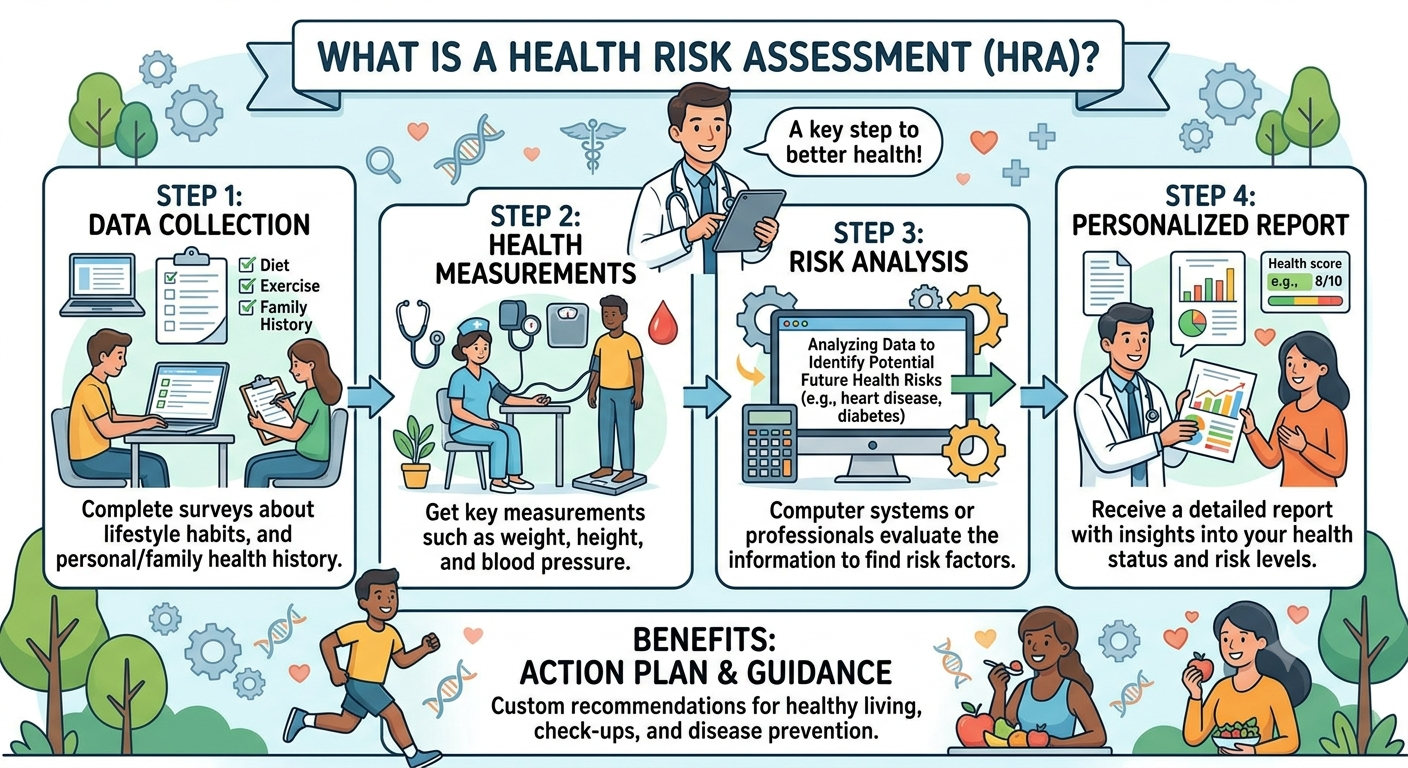
A Health Risk Assessment is a structured questionnaire that evaluates your likelihood of developing a serious health condition, diabetes, hypertension, heart disease, obesity-related illness, based on your current lifestyle, medical history, and biological markers.
It is not a diagnosis. An HRA does not tell you that you have a disease. It tells you how much risk you are accumulating, and in which areas, so you can act on it before it becomes a diagnosis.
The key distinction is that an HRA captures what a blood test cannot: how you actually live. How much you move. What you eat. How you sleep. Whether your parents or grandparents had heart disease. Whether you are under chronic stress. These are not things a lab report measures, but they are the variables that drive most of India's disease burden.
Why India Specifically Needs This
India faces what epidemiologists call a "double burden" of disease: we still carry a high load of infectious illness, while simultaneously experiencing one of the fastest rises in non-communicable diseases (NCDs) in the world.
According to the Indian Council of Medical Research, NCDs now account for nearly 63% of all deaths in India. Cardiovascular disease, diabetes, and chronic respiratory conditions are the leading killers, and the vast majority of cases are lifestyle-driven, which means they are preventable with early intervention.
The tragedy is that most of these conditions give years of warning before they become serious. Prediabetes can precede Type 2 diabetes by a decade. Borderline hypertension rarely presents symptoms. Elevated cardiovascular risk is silent until it is not.
An HRA is how you hear those early warnings.
What an HRA Actually Measures
A well-designed health risk assessment covers six areas:
1. Physical metrics Height, weight, waist circumference, and BMI give a baseline picture of body composition and metabolic risk. Waist circumference in particular is a stronger predictor of cardiovascular risk than BMI alone, something most standard health check-ups do not flag.
2. Lifestyle habits Diet quality, physical activity levels, alcohol intake, and tobacco use are scored against established clinical benchmarks. The Healthness+ HRA uses WHO physical activity guidelines and Indian dietary reference values as its baseline, not generic Western standards.
3. Family history Genetic predisposition matters. A parent with Type 2 diabetes roughly doubles your lifetime risk. A family history of early cardiovascular events is one of the strongest independent predictors of your own cardiac risk. An HRA systematically captures this, a routine blood test does not ask.
4. Biometric markers (self-reported or verified) Blood pressure, resting heart rate, and fasting blood sugar (if you have a recent reading) are factored in when available. The HRA will still run meaningfully without these, but including them sharpens the accuracy of your risk score.
5. Stress and sleep Chronic stress and poor sleep are causally linked to hypertension, metabolic syndrome, and immune dysfunction. They are also two of the most underdiagnosed contributors to poor health in India's working-age population. The HRA quantifies them, not as soft lifestyle factors but as measurable risk inputs.
6. Occupational and environmental factors Sedentary work, long commutes, irregular meal timings, and urban air quality all load additional risk that most health assessments ignore. These are included in a comprehensive HRA.
HRA vs Health Check-Up: They Are Not the Same Thing
A common question: I already get an annual health check-up. Why do I need an HRA?
Your annual check-up measures what is happening in your body right now. An HRA measures where your body is heading based on how you are living. They answer different questions.
Think of it this way: a blood test tells you your fasting blood sugar is 95 mg/dL, within normal range. An HRA tells you that your diet, activity level, family history, and stress load put you on a trajectory toward prediabetes within five to seven years. One is a photograph; the other is a map.
The ideal is to use both. But if you have not done either recently, the HRA is the faster, lower-cost starting point. It costs nothing, takes about 15 minutes, and gives you actionable output immediately.
How to Read Your Results: Green, Amber, and Red
The Healthness+ HRA scores your risk across each domain and gives you an overall risk classification:
Green Zone means your current lifestyle and health markers are within safe parameters. The goal is maintenance and monitoring, keeping what you have built.
Amber Zone means you have identified areas of elevated risk that are not yet causing harm but will if left unaddressed. This is the most important zone to catch: you have time, and the corrections needed are usually manageable lifestyle adjustments rather than medical intervention.
Red Zone means you have risk factors that require prompt attention, either a conversation with a doctor, a diagnostic workup, or a structured intervention. Red does not mean you are sick. It means the situation has urgency.
Most people who do an HRA for the first time land in Amber. That is normal for an adult in their 30s or 40s in urban India. It is also the most valuable place to be, because it means the trajectory is still reversible.
What Happens After Your HRA
The HRA result is the beginning of the process, not the end of it.
A risk score without a plan attached to it is just a number. What matters is what you do next, and that depends on which specific risk areas your HRA flagged.
At Healthness+, every completed HRA generates a personalised health profile that identifies your top risk areas and links them to specific, actionable corrections. These are not generic recommendations ("eat less sugar, exercise more"). They are prioritised, sequenced suggestions based on your specific profile, what to address first, how to address it, and how to track progress.
For users in the Amber and Red zones, a Healthness+ health coach reviews your profile and maps out a correction plan alongside you. The goal is not to put you on a permanent programme. It is to give you the understanding and tools to manage your own health trajectory going forward.
Who Should Do an HRA?
Everyone over the age of 25 benefits from knowing their risk profile. But the HRA is especially relevant if:
- You have a family history of diabetes, heart disease, or hypertension
- You have a sedentary job and limited physical activity
- You are in your 30s or 40s and have not had a health review in over a year
- You have noticed changes in weight, energy, or sleep quality
- You are managing a high-stress workload for extended periods
You do not need to feel unwell to benefit from an HRA. The point is to act before you do.
Take Your Free Health Risk Assessment
The Healthness+ Health Risk Assessment takes 15 minutes, is completely free, and gives you a personalised risk profile with specific next steps, not a generic report.
If you have been telling yourself you will "get around to it," this is the nudge. Your results are ready the moment you finish.