In fifteen years of practising general medicine, I have seen the same pattern repeat itself more times than I can count.
A patient in their mid-forties comes in with chest discomfort, fatigue, or blurred vision. We run the workup. The results show a fasting blood sugar of 220, blood pressure of 160/100, and a lipid profile that has clearly been deteriorating for years. The patient is shocked. They felt fine. How did this happen?
It did not happen suddenly. It built quietly, over a decade of small, cumulative choices and risks that nobody measured because nobody thought to look.
This is the defining failure of how most Indians approach their health: we treat illness but we do not prevent it. And that gap is now costing us, in lives and in money, at a scale that is genuinely alarming.
India's NCD Crisis: The Numbers Behind the Pattern
Non-communicable diseases, heart disease, diabetes, hypertension, chronic respiratory conditions, and obesity-related illness, now account for approximately 63% of all deaths in India, according to the Indian Council of Medical Research.
To put that in clinical terms: the majority of people dying in this country are not dying from infections or injuries. They are dying from conditions that develop slowly, give years of warning signs, and are largely preventable with timely intervention.
The World Health Organization estimates that India loses over 25 million years of productive life annually to cardiovascular disease alone. The International Diabetes Federation places India second in the world for diabetes prevalence, with over 77 million diagnosed cases and an estimated 25 million more undiagnosed.
Hypertension is perhaps the most striking example. Studies suggest that fewer than 12% of hypertensive Indians have their blood pressure adequately controlled. Not because treatment is unavailable, but because most patients do not know they have it. Hypertension is silent. It presents no symptoms until it causes a stroke, a heart attack, or irreversible kidney damage.
These are not statistics about a distant public health problem. In my clinic, they are the patients I see every week.
The Real Cost of Reactive Healthcare
India's healthcare system is overwhelmingly reactive. We build hospitals; we train specialists; we invest in treatment. What we have systematically underinvested in is prevention.
This is a rational response to visible, immediate need, but it is an economically irrational one in the long run.
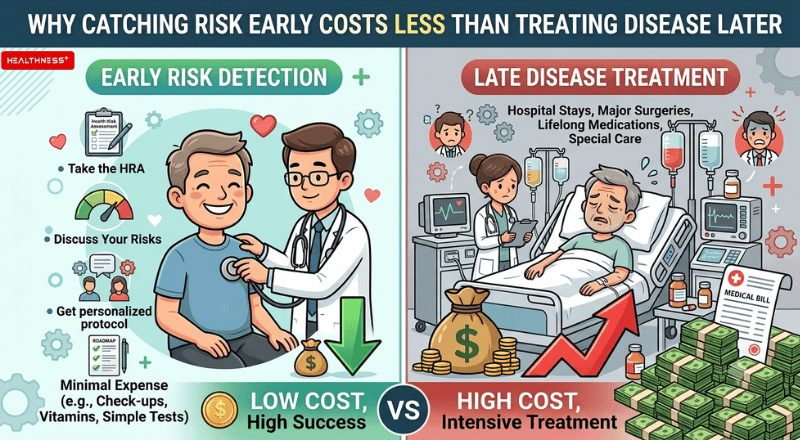
Consider the numbers for Type 2 diabetes. Managing a diabetic patient with standard medication, monitoring, and annual investigations costs approximately ₹15,000 to ₹25,000 per year. If that patient develops diabetic nephropathy and requires dialysis, the annual cost rises to ₹6 to 10 lakh. A kidney transplant, when it comes to that, costs ₹5 to 15 lakh as a one-time expenditure, followed by lifelong immunosuppressive therapy.
Compare this to the cost of early intervention at the prediabetes stage, structured dietary guidance, a physical activity programme, and regular monitoring, which costs a fraction of that, and which, according to the landmark Diabetes Prevention Programme study, reduces progression to Type 2 diabetes by 58% in high-risk individuals.
The same arithmetic applies to cardiovascular disease, hypertension, and metabolic syndrome. Catching risk early is not just better medicine. It is dramatically more economical, for the patient, for their family, and for the healthcare system as a whole.
The Three Stages of Prevention. And Where India Gets Stuck
Prevention in medicine is not a single intervention. It operates across three distinct stages, each with a different objective:
Primary prevention means acting before any disease process has begun. Vaccination is the canonical example. For NCDs, this means addressing lifestyle risk factors, sedentary behaviour, tobacco use, poor diet, chronic stress, in people who are currently healthy.
Secondary prevention means identifying disease in its earliest, pre-symptomatic stage and intervening before it causes harm. Screening programmes, blood pressure measurement, blood glucose testing, HRA-based risk stratification, fall here. The goal is to catch the condition while treatment is still simple and outcomes are still reversible.
Tertiary prevention means managing an established disease to prevent complications and deterioration. This is where most Indian healthcare spending goes, and where the outcomes are, by definition, limited by what has already occurred.
India's challenge is that the vast majority of healthcare engagement happens at the tertiary stage. Patients arrive at a facility when they are already symptomatic. By the time a patient sees me for the first time about their blood pressure, it has often been elevated for five to ten years.
The critical gap is secondary prevention: systematic, accessible screening that identifies risk before it becomes disease.
Why Preventive Healthcare Adoption Remains Low
Given this evidence, why do so few Indians engage with preventive healthcare proactively?
In my clinical experience, the barriers are consistent across demographics:
Perceived invincibility. Most adults under fifty feel well. Feeling well is mistaken for being well. The absence of symptoms is treated as evidence of health, a logical inference, but an incorrect one for most NCDs.
Cost concerns, real and perceived. Many patients assume preventive health checks are expensive. In reality, a Health Risk Assessment costs nothing, and even comprehensive preventive blood panels at good diagnostic labs now run between ₹800 and ₹3,000. The cost objection is often a proxy for not seeing the value.
Fatalism. "If something is wrong, I will find out eventually", a view I encounter regularly, particularly among patients with known family histories of serious illness. This is not indifference; it is, in some cases, anxiety avoidance. But it is a view that health education can change.
Access. In tier 2 and tier 3 cities, and in rural India, a visit to a doctor for a preventive review, where nothing is wrong and no prescription is expected, still feels like a misuse of medical resources. This is a cultural norm that needs updating.
What a Preventive Health Strategy Looks Like in Practice
I am frequently asked what "taking prevention seriously" actually means in daily life. The answer is simpler than most patients expect.
It begins with knowing your numbers. Blood pressure, fasting blood glucose, BMI, waist circumference, and lipid profile. These five metrics, reviewed annually, give a clinician enough to assess your trajectory and intervene meaningfully if needed. If you are over 35 and do not know your most recent values for all five, that is the starting point.
It continues with honest lifestyle accounting. Not an idealised version of your diet and activity levels, an honest one. Most patients significantly underestimate their sedentary hours and overestimate their dietary quality. A structured health risk assessment helps calibrate this by asking specific, measurable questions rather than relying on self-evaluation.
It requires consistency over intensity. A thirty-minute walk five days a week, maintained across years, does more for cardiovascular risk than aggressive short-term exercise bursts followed by months of inactivity. The evidence on this is unambiguous.
And it means acting on what the assessment finds. A risk profile is only valuable if it changes behaviour. The most common failure point in preventive health is not ignorance. It is the gap between awareness and action.
How Digital Tools Are Changing Access to Preventive Care
One of the more meaningful shifts I have observed in recent years is the emergence of digital health platforms that make secondary prevention accessible at scale.
A clinical-grade Health Risk Assessment, delivered online and personalised to the individual's lifestyle, family history, and biometric data, removes the single largest barrier to preventive health engagement: the need to see a doctor before anything is visibly wrong.
When a patient completes an HRA and receives a risk score that flags elevated cardiovascular risk or prediabetes trajectory, they have something concrete to act on. They come into the clinic with a question, not a crisis. That is a fundamentally different conversation, and a far better clinical outcome.
Platforms like Healthness+ are not replacing clinical medicine. They are filling the gap that clinical medicine, by its nature, cannot fill: the years between appointments, the conditions that present no symptoms, the risk that accumulates in the absence of anyone asking the right questions.
The Recommendation Is Simple
If you are an adult in India, particularly if you are over thirty, have a family history of any NCD, work a sedentary job, or live with chronic stress. You owe yourself a current picture of your health risk.
Not because something is probably wrong. But because if something is building, the time to address it is before you feel it, not after.
A Health Risk Assessment takes fifteen minutes. It asks the questions a preventive health review should ask. It gives you a risk profile mapped to your specific inputs, not a generic score. And it is free.
Start there. Everything else follows from knowing where you actually stand.