
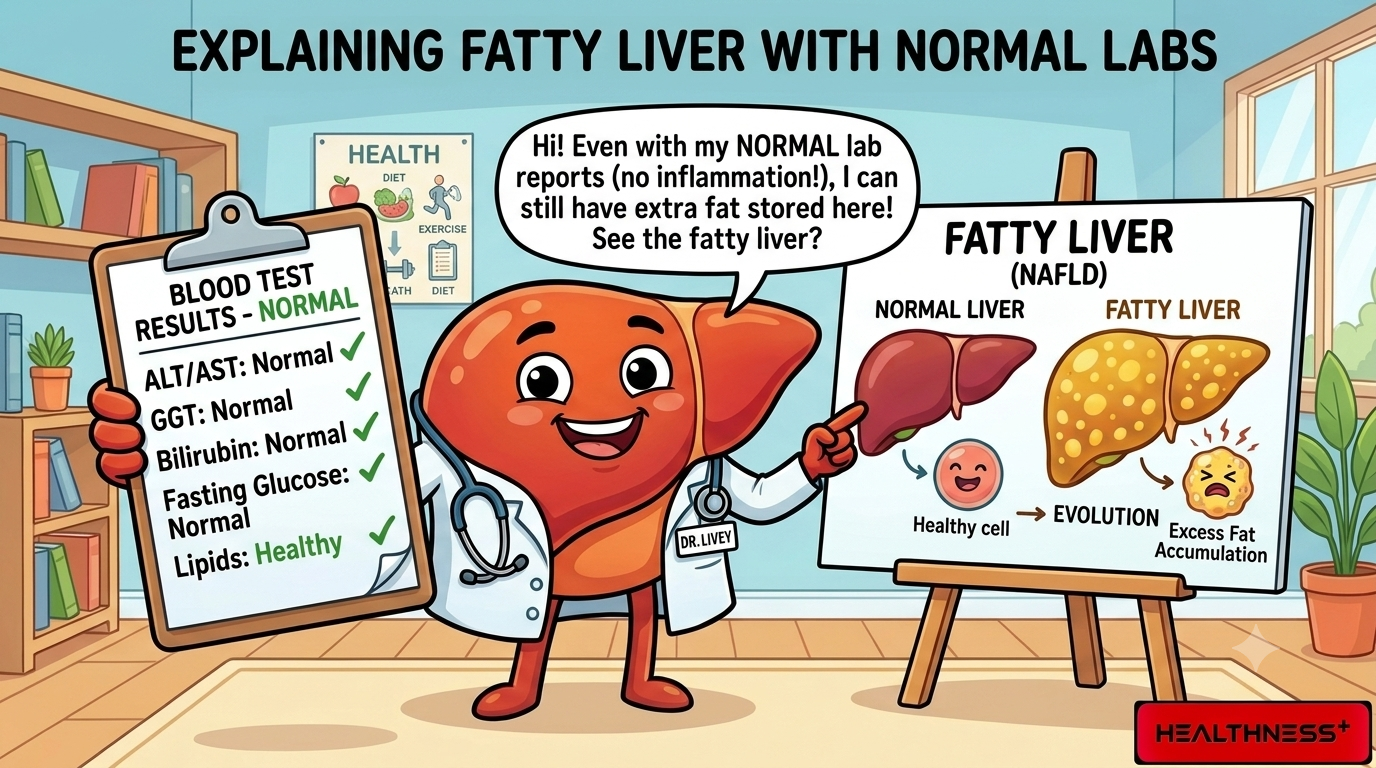
Every week, someone sits across from me holding a folder of reports and the same question. "Doctor, everything is normal. So why do I feel like this?"
They are usually between 35 and 50. They are tired by mid-afternoon. Their trousers have gone up a size or two over the last few years. They sleep, but they do not wake up rested. Their sugar is "fine", their liver test is "fine", and their last checkup said nothing to worry about.
When we look a little closer, a good number of them have fat building up in their liver.
This is one of the most common problems in Indian adults today, and one of the most missed. I want to explain why it hides so well, what actually finds it, and what you can start doing this week.
How Common Is It, Really? More common than most people imagine.
A large study from the Phenome India cohort, published this year in The Lancet Regional Health: Southeast Asia, estimates that roughly 4 in 10 Indians have fat in the liver that is not caused by alcohol. A smaller but meaningful share already show early scarring (fibrosis).
Apollo Hospitals' 2026 Health of the Nation report found something even more striking. Among people whose routine health check results looked normal, nearly three in four showed signs of fatty liver when examined more closely.
Read that again. Normal reports, and a liver quietly storing fat.
Why "Normal" Reports Miss It There are three reasons.
-
The liver does not complain. The liver has no pain-sensing nerves inside it. It can store excess fat for years without causing any obvious symptom. By the time someone feels unwell because of their liver, the problem is usually well advanced.
-
Liver enzymes can be normal. Most checkups include SGPT (ALT) and SGOT (AST). Many people assume that if these are in range, the liver is healthy. But a significant number of people with fatty liver have perfectly normal enzyme values. A normal SGPT is reassuring. It is not a clean bill of health.
-
Nobody connects the dots. A slightly high triglyceride here, a borderline fasting sugar there, a waist that has grown, an HDL that is a little low. Each value on its own looks minor. Together, they tell a story, and the liver is often at the centre of it.
Doctors now call this condition MASLD, which stands for metabolic dysfunction-associated steatotic liver disease. The new name matters. It tells us that fatty liver is not really a "liver problem" in isolation. It is a sign that the body's metabolism is under strain.
Fatty Liver in Men: What to Watch For One of the most searched questions in India this month is about fatty liver symptoms in men. The honest answer is that the early signs are the same for everyone, and they are easy to dismiss.
Men, however, tend to store excess fat around the abdomen and the organs (visceral fat) from a younger age. Women are partly protected by oestrogen until menopause, after which their risk rises sharply too. So in my experience, the pattern often shows up first in men in their thirties and forties.
The quiet signs I look for:
A growing waist, even if your weight looks "okay". For Indian adults, a waist above 90 cm (about 35.5 inches) in men or 80 cm (about 31.5 inches) in women is a flag. Tiredness that rest does not fix, especially an energy dip after meals. A feeling of heaviness or dull discomfort on the upper right side of the abdomen. High triglycerides or low HDL on a lipid report. Borderline sugar values, such as a fasting sugar creeping towards 100 or an HbA1c in the high-normal range. Difficulty losing weight, even when you feel you are eating less. None of these on its own means you have fatty liver. But if you recognise three or four of them, it is worth looking properly.
The recent ICMR-INDIAB findings on cholesterol point in the same direction: abdominal fat turned out to be a stronger predictor of abnormal lipids than age or smoking. Your waistline is telling you more than the bathroom scale.
Why It Matters Before It Hurts Fat in the liver is not just stored quietly. A liver loaded with fat becomes less responsive to insulin. The pancreas works harder to compensate. Triglycerides rise. Over time, this raises the risk of lifestyle diseases (NCDs) such as type 2 diabetes, heart disease and high blood pressure.
In a smaller group of people, the fat causes inflammation, then scarring, and over many years can progress to cirrhosis. That is the stage nobody wants to reach, and the reason to act early.
The encouraging part is that, at the early stage, the liver is one of the most responsive organs in the body. International liver guidelines note that losing around 5% of body weight is associated with a meaningful fall in liver fat, and 7 to 10% with improvement in inflammation. These are not dramatic numbers. For an 80 kg person, 5% is 4 kg.
The Tests That Actually Find It If your routine reports look normal but the signs above sound familiar, these are the conversations to have with your doctor:
Ultrasound of the abdomen. Simple, widely available and inexpensive. It can show fat in the liver and give it a grade. FIB-4 score. This is a calculation, not a new test. It uses your age, SGOT, SGPT and platelet count, all of which are usually already on your reports. It helps estimate whether scarring is likely. FibroScan (transient elastography). A painless scan that measures liver stiffness and fat. It is useful when the ultrasound or FIB-4 suggests a closer look is needed. A full metabolic picture. HbA1c, fasting insulin where advised, a lipid profile and your waist measurement, read together and not one value at a time. A Simple Indian 7-Day Eating Pattern to Start With This is not a crash diet and it is not a prescription. It is the kind of everyday Indian eating pattern we coach towards, built on food you already know. The principles are simple:
Half your plate vegetables, a quarter protein (dal, chana, rajma, paneer, eggs, fish, chicken), a quarter whole grains or millets. Cut the liquid sugar first. Packaged fruit juice, sweetened tea and coffee, soft drinks and "health drinks" put a direct load on the liver. Swap maida for whole grains. Jowar, ragi, bajra, brown rice, broken wheat and whole wheat in place of white bread, biscuits and refined flour snacks. Cook with less oil, and rotate oils rather than relying on one. Keep deep-fried food to an occasional treat. Eat dinner earlier and lighter, ideally two to three hours before sleep. Limit alcohol, and ideally avoid it, if your liver is already carrying fat. Here is a sample week to make it practical:
Monday
Breakfast: Vegetable poha with peanuts Lunch: 2 jowar rotis, dal, bhindi sabzi, salad Evening: Buttermilk, roasted chana Dinner: Moong dal chilla, mint chutney, sautéed vegetables Tuesday
Breakfast: Ragi dosa, sambar Lunch: Brown rice, rajma, cucumber raita Evening: 1 guava or apple Dinner: Vegetable soup, paneer bhurji, 1 roti Wednesday
Breakfast: 2 boiled eggs or besan chilla, 1 slice whole wheat toast Lunch: Bajra roti, palak dal, carrot salad Evening: Unsweetened tea, handful of nuts Dinner: Grilled fish or tofu, stir-fried vegetables Thursday
Breakfast: Vegetable upma (broken wheat) Lunch: 2 rotis, chana masala, cabbage sabzi, curd Evening: Sprouts chaat Dinner: Khichdi with extra vegetables, salad Friday
Breakfast: Idli with sambar Lunch: Millet pulao, dal, beans poriyal Evening: Buttermilk Dinner: Chicken or paneer tikka, large salad, 1 roti Saturday
Breakfast: Oats or daliya with vegetables Lunch: Rice (small portion), sambar, rasam, vegetable kootu Evening: 1 orange or papaya bowl Dinner: Vegetable thepla, curd, salad Sunday
Breakfast: Methi paratha (light oil), curd Lunch: Home-style thali, smaller rice portion, more sabzi Evening: Roasted makhana Dinner: Light dal soup, sautéed vegetables, 1 roti A few practical notes:
Fruit is fine. Juice is not. Whole fruit comes with fibre that slows the sugar. Juice does not. Watch the "healthy" snacks. Namkeen, baked chips and granola bars often hide refined flour, oil and sugar. Walk after meals. A 10 to 15 minute walk after lunch and dinner is one of the simplest habits to build. Festive season is coming. You do not have to skip sweets. Have them after a meal rather than on an empty stomach, share portions, and keep the rest of the day lighter. Food is only one part of the picture. Sleep, stress and movement all affect how the body handles fat. Poor sleep and long-term stress push the body towards storing more fat around the middle, which is exactly where the liver feels it.
What We Do Differently at Healthness+ Most people do not get a fatty liver diagnosis because nobody looks at the whole picture early enough. That is the gap Healthness+ was built for.
Healthness+ is a digital therapeutics (DTx) platform. We have developed an AI-driven, multi-marker predictive algorithm, and we continue to hone it. It reads your health risk assessment, your daily lifestyle tracking and your blood reports together, so a borderline value here and a growing waist there are seen as one pattern, not as isolated numbers. The aim is to spot the load building up early, and then support you through daily coaching to change the habits behind it.
We do not promise a number on a scale or a result by a date. What we offer is earlier visibility and steady, practical support.
Where to Start Today Measure your waist at the level of your navel. Write it down. Pull out your last reports and look at triglycerides, HDL, fasting sugar or HbA1c, SGPT and SGOT together. Ask your doctor whether an abdominal ultrasound or a FIB-4 calculation makes sense for you. Take the free Healthness+ Health Risk Assessment at healthnessplus.com/hra. It takes a few minutes and gives you a clear picture of where your risk sits across your body's systems. A normal report is good news. But it is not the whole story. The liver will not tell you it is struggling. You have to ask.
This article is for general awareness and is not a substitute for medical advice. Please consult your doctor before making changes to your diet, medication or exercise routine, especially if you have an existing health condition.